Our region’s leadership in clean, reliable, and community-centered energy innovation is built on collaboration, data, and shared learning. Below you’ll find cornerstone reports that highlight the progress, partnerships, and priorities shaping the Novara Energy Alliance and our collective path toward a brighter energy future.
Governance Creation and Cluster Buildout Report (ICAP Final Report)
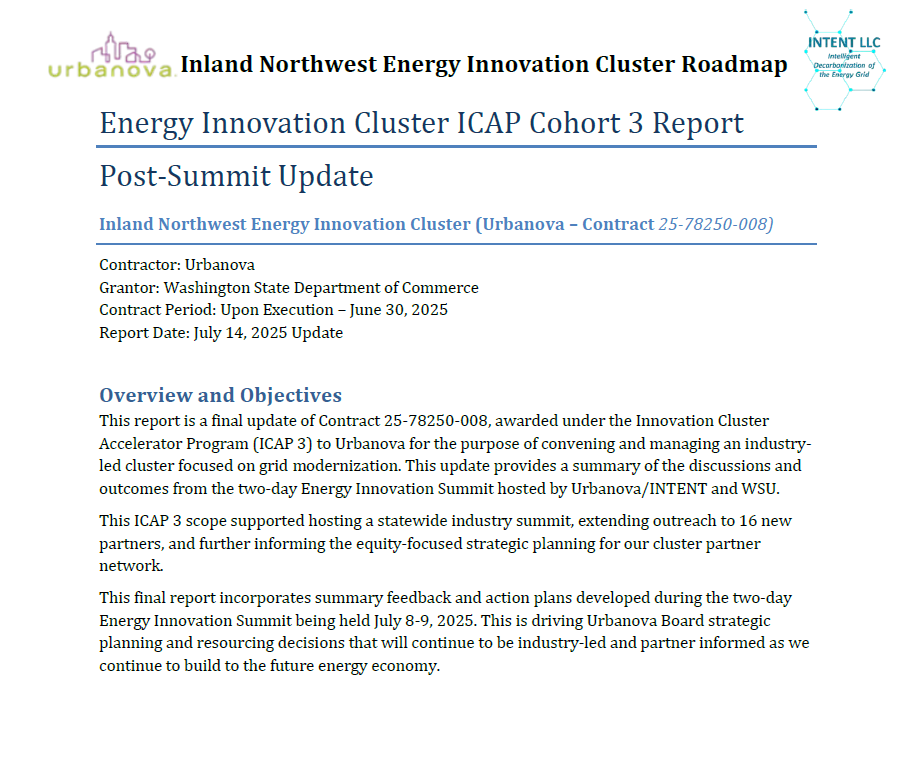
Prepared for the Washington State Department of Commerce, this post-summit report captures outcomes from the July 2025 Energy Innovation Summit—a milestone convening that expanded partnerships, defined priority actions across workforce, research, and investment, and accelerated development of the Inland Northwest Energy Innovation Cluster.

Building a sustainable pathway as the Inland Northwest Energy Innovation Cluster
This presentation Greater Spokane Incorporated’s Economic Development Committee, situates the Inland Northwest’s emerging energy cluster within a broader economic context. It illustrates how regional assets—hydropower, national labs, universities, and industry partners—are aligning to address load growth, transmission constraints, and the $21 trillion global grid modernization opportunity.
Advancing Energy and Decarbonization Technologies in
the Inland Northwest (Two Year Report)
This report documents the formation and early success of the Inland Northwest Center for Energy and Decarbonization (INTENT), launched under the NSF Regional Innovation Engines program. It highlights the region’s strengths in energy research, industry collaboration, and equitable grid modernization, and outlines the roadmap that led to the merger forming the Novara Energy Alliance.

Preliminary Findings on the Mix of Smart Grid Occupations & Forecast in Eastern Washington & Northern Idaho
Conducted by Eastern Washington University’s Institute for Public Policy and Economic Analysis, this report provides a baseline workforce analysis for the clean-energy transition. It identifies critical engineering and technical occupations concentrated in Eastern Washington and Northern Idaho, offering insight into training, upskilling, and workforce-development priorities across the regional energy ecosystem.
