The Inland Northwest is not content to wait for the future of energy to arrive. The challenges facing our region – including rising demand, aging infrastructure, affordability pressures, extreme weather, wildfire risk and evolving security threats – are already here. Solving those challenges requires a collective sense of urgency, practical innovation and a new level of collaboration.
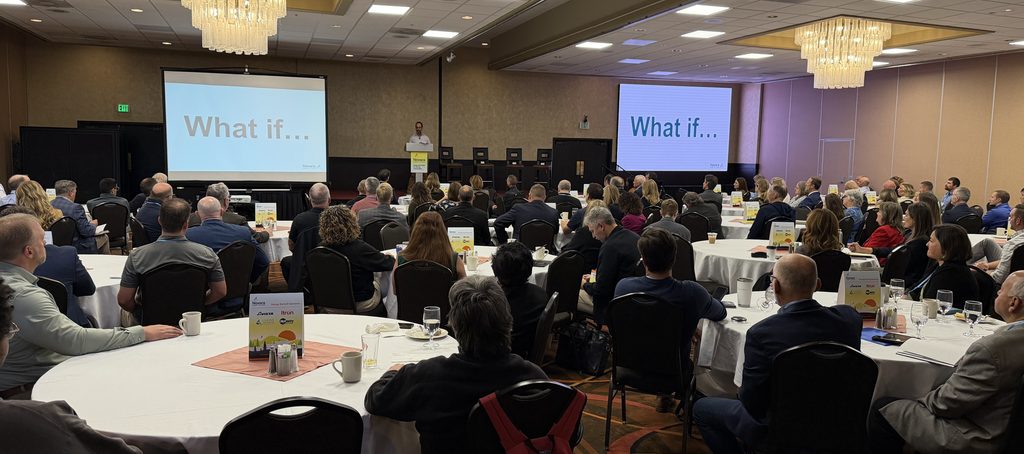
That imperative brought approximately 140 leaders together at the Novara Energy Summit earlier this month, representing utilities, energy services, industry suppliers, government, nonprofit organizations and tribes. Across executive conversations, expert perspectives and focused breakout sessions, one message came through clearly: No single organization can solve the region’s most pressing energy challenges alone.
A Shared Vision for the Inland Northwest
At the summit, the Novara Energy Alliance shared a bold vision to establish the Inland Northwest as a nationally recognized center for energy innovation. Our region has the essential ingredients to make that vision real: cooperative utilities, strong suppliers, nationally respected universities, a national laboratory, and access to diverse, real-world testing environments.
Just as important, the Inland Northwest reflects a broad range of communities and perspectives, from urban centers to rural communities and from agriculture to industry. That diversity can help innovators gather feedback quickly, test ideas under varied conditions, and develop durable solutions that serve multiple stakeholders.
Our opportunity is to turn these strengths into an organized regional advantage. What if a focused group of utilities could agree on two or three mission-critical problems and collaborate on how solutions are tested and piloted? The result could be a uniquely valuable proving ground for approaches that scale beyond the Inland Northwest.
Seeing the System and the Opportunity More Clearly
Summit speakers underscored that the energy system is at an inflection point. PNUCC Executive Director Crystal Ball and Northwest Gas Association CEO Kelly Fukai provided an overview of our region’s rising demand and the forecast supply gap.
During a dynamic executive panel, Heather Rosentrater, president and CEO of Avista; Tom Deitrich, president and CEO of Itron; and Ash Awad, president and CMO of McKinstry, emphasized the need for greater visibility, flexibility and control across the grid.
The conversation also highlighted the importance of moving ideas beyond isolated demonstrations. Our region does not lack ideas; the challenge is operationalizing them, testing them in real-world conditions, and scaling what works. That means designing pilots with scale in mind and bringing multiple utilities, technology providers, researchers, policymakers and communities together earlier.
Three Pressures Shaping our Energy Future
Power Perspectives sessions examined energy supply, energy resilience and energy affordability. Our speakers provided diverse perspectives and included David Clukey – Inland Power & Light, Paul Dietz – Grant County PUD, Scott Kinney – Avista, Chelsea Martin – Modern Electric Water Company, Jim Ogle – Pacific Northwest National Lab, Jeff Owen – Itron, Michael Schleich – Pend Oreille PUD, Dr. Dan Schwartz – UW Clean Energy Institute, Dale Silha – McKinstry, and Dr. Mani Venkatasubramanian – WSU Energy Systems Innovation Center.
Several takeaways from these rapid-fire talks stood out:
- The adequacy gap is growing. Regional forecasts discussed at the summit point to a winter peak shortfall of approximately 13 gigawatts by 2036. With gas delivering a significant share of the region’s energy, planning for electricity and gas must be considered together.
- Current regulatory structures can make it difficult for utilities to move at the pace the moment requires. More flexibility is needed.
- Wildfire and extreme weather do not respect utility boundaries. Smaller utilities face the same issues as large utilities, but are being asked to do more with limited resources.
- Affordability is being squeezed from many directions. Grid investment, load growth, wildfire costs, policy requirements, constrained hydropower, supply chain challenges, inflation and labor costs are all contributing. There is no single cause and no single fix.
- No resource alone is enough. Efficiency, flexible demand and virtual power plants could address a meaningful portion of the projected supply gap faster and at lower cost than new supply alone. However, new generation, storage and transmission are still needed.
Together, these insights reinforce the need to look beyond either-or choices. The region will need a coordinated portfolio of solutions that provide multiple benefits, for example, the win-win of battery backup for increased resiliency plus potential peak shaving.
Trust and Education Are Foundational
Breakout sessions on supply, resilience and affordability were facilitated by Ryan Arnold of Avista, Erik Budsberg of McKinstry, and Juliet Sinisterra of the Spokane University District. The sessions surfaced different technical priorities, but all three reached a consistent conclusion: Progress depends on trust and understanding across the energy ecosystem.
Participants identified the need for alternative baseload options and more testing and piloting for energy supply, improved risk modeling and clearer best practices for resilience, and faster transmission deployment to support affordability. They also stressed that communities need accessible information and meaningful opportunities to participate.
Regional collaboration cannot be an afterthought. It is critical to how we design, test and scale durable solutions that benefit multiple stakeholders.
Turning Summit Input into Action
The summit was an important milestone, but it is just the beginning. Our next step is critical: We need alignment on which specific problems our alliance should pursue. Novara will now aggregate the challenges and ideas raised at the event and combine them with insights from earlier work. We plan to convene a working group of utilities and energy-sector partners to review the findings, deepen our understanding of each challenge, and apply selection criteria, including potential impact and time to impact.
With that group’s guidance, Novara Energy Alliance will identify three priority problems. Ideally, by focusing the region’s expertise and resources on a small number of shared challenges we can create the right conditions for coordinated testing, faster learning, and accelerate the path to scale.
Building a successful alliance will take continued participation from those who attended the summit and from many others across the region. We invite utilities, businesses, researchers, public agencies, nonprofits, tribes, community leaders and other energy stakeholders to stay engaged, share feedback, and help shape what comes next.
Together, we can move from fragmented efforts to coordinated action and make the Inland Northwest a nationally recognized center for energy innovation.